
Analyzing the shift from paper records to online portals—and why continuous verification matters for urban local bodies.
Executive Summary
As Indian metropolitan centers experience unprecedented growth in companion animal density, Urban Local Bodies (ULBs) face a dual imperative: enforcing statutory civic licensing while achieving verifiable disease surveillance under the central government’s National Action Plan for Dog Mediated Rabies Elimination (NAPRE by 2030).
While municipal authorities—such as the Greater Hyderabad Municipal Corporation (GHMC)—have made commendable progress by simplifying citizen-facing digital intake forms, a critical operational gap remains between one-time municipal filing and continuous, lifetime verification.
This brief examines the structural evolution of civic pet administration in India and outlines how independent, verifiable digital health ledgers bridge the last-mile divide between municipal records, private veterinary clinics, and high-density residential societies.
1. The Macro Imperative: The One Health & NAPRE 2030 Mandate
Under the National Action Plan for Dog Mediated Rabies Elimination from India by 2030 (NAPRE), spearheaded by the Ministry of Health and Family Welfare (MoHFW) and the Ministry of Fisheries, Animal Husbandry & Dairying, public health strategy has transitioned to a comprehensive One Health model.
Achieving canine-mediated rabies elimination requires:
- Maintaining documented herd immunity (>70% sustained vaccination coverage).
- Accurate mapping of domestic pet density versus community animal populations across municipal wards.
- Rapid, verifiable traceability during bite investigations and containment protocols.
Historically, municipal pet licensing and rabies tracking existed in administrative silos. Offline paper registration resulted in compliance rates lingering below 10% across most Indian Tier-1 metros, denying urban epidemiologists the verifiable data necessary to monitor transmission vectors.
2. The First Phase of Reform: Portal Simplification (The Hyderabad Case Study)
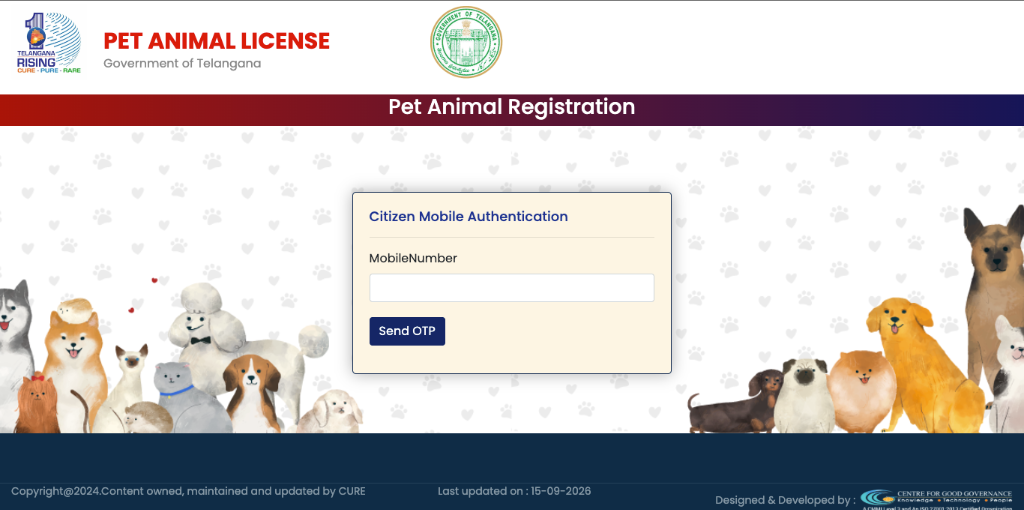
In response to low civic compliance, municipal administrations have initiated digital intake modernization. The Greater Hyderabad Municipal Corporation (GHMC) exemplifies this transition by reducing bureaucratic friction:
- Eliminating Multi-Departmental Bureaucracy: Transitioning from physical visits to circle offices toward a streamlined single-page digital interface (petanimal.ghmc.gov.in/login/).
- Lowering Compliance Barriers: Requiring core citizen and animal identifiers, photographic verification, and Anti-Rabies Vaccination (ARV) confirmation without prohibitive administrative hurdles.
- Statutory Alignment: Explicitly linking companion animal licensing with the Wildlife (Protection) Act, 1972, ensuring native and recognized domestic animals are registered while curbing illegal exotic wildlife captivity.
| Dimension | Legacy Framework (Analog) | Emerging Framework (Digital) |
|---|---|---|
| Intake Mechanism | In-person circle office visits & physical stamps | Streamlined citizen web portals |
| Verification Basis | Physical stamp paper / receipts | Direct mobile-based verification |
| Data Architecture | Fragmented ward paper files | Centralized municipal databases |
| Citizen Friction | Annual compliance < 10% | Lower friction for citizens |
3. The Last-Mile Challenge: Static Filing vs. Continuous Verification
While simplified municipal portals resolve the initial data intake bottleneck, they do not resolve the operational lifecycle challenge. Companion animal governance requires continuous, multi-stakeholder verification:
Municipal Filing (ULB)
(Single-point timestamp)
Residential Societies / RWAs
(Requires daily, mobile verification at gates)
Private Veterinary Care
(Administers annual ARVs, boosters, and surgery)
- The Annual Booster Disconnect:Rabies immunization is not a permanent status; it requires strict 12-month booster cycles. A static civic registration issued in January does not inform municipal officers or residential security whether an animal’s immunity has lapsed by December.
- The Private-Public Clinical Divide:Over 85% of companion animal healthcare in urban India is delivered through private veterinary practices, independent clinics, and charitable hospitals. Municipal databases generally lack automated mechanisms to sync with private veterinary diagnostic records.
- The Residential Friction Point:Resident Welfare Associations (RWAs) in high-density gated corridors (such as Hitec City, Gachibowli, and Kondapur) routinely require on-demand proof of rabies immunity. When a pet owner’s only document is a municipal filing acknowledgment or a paper card, friction between housing boards and residents escalates.
4. The Solution Architecture: Complementary Digital Identity Infrastructure
To solve this last-mile verification challenge without burdening municipal IT infrastructure, the companion animal ecosystem requires an independent, complementary digital health and identity layer.
Under KR PET EYE LLP, the PetEYE platform functions as a neutral infrastructure layer designed to support both citizens and regulatory frameworks:
- Consolidated Lifetime Health Wallet:Pet parents can securely aggregate their government registration reference, private veterinary vaccination booklets, microchip credentials, and sterilization certificates into a unified digital record.
- Tamper-Evident Dynamic QR Pass:Generates a verifiable, mobile-accessible credential. Housing societies, transit operators (Indian Railways, domestic airlines), and boarding facilities can scan the pass to confirm active vaccination and civic status in real time.
- Ecosystem Interoperability:By creating a structured data standard for pet health histories, digital identity bridges the gap between civic requirements and daily life, converting formal registration from a bureaucratic obligation into a practical asset for the pet owner.
5. Strategic Recommendations for Urban Local Bodies
To accelerate civic compliance and achieve NAPRE 2030 milestones, KR PET EYE LLP recommends a three-pronged institutional roadmap for municipal administrations:
- Incentivize Digital Proof for Citizens: Recognize verified digital identity passes as valid evidence of municipal compliance during residential housing audits and transit clearances.
- Integrate Veterinary Sign-Offs: Establish standardized digital verification channels where registered veterinarians can validate rabies boosters, reducing fraudulent self-declarations.
- Adopt Ward-Level Immunization Analytics: Utilize anonymized aggregate compliance heatmaps to identify under-vaccinated municipal wards, enabling targeted public health drives and optimized animal birth control (ABC) allocation.
Conclusion
The modernization of municipal pet portals in cities like Hyderabad represents a decisive step forward for urban governance in India. However, the ultimate success of public health initiatives like NAPRE 2030 depends on transforming one-time civic filings into a living, verifiable standard.
By pairing municipal portals with open, reliable digital health infrastructure, India’s urban centers can build safer, compliant, and more accountable communities for both citizens and companion animals.
For policy inquiries, municipal collaboration discussions, or institutional whitepapers, contact KR PET EYE LLP at:corporate@krpeteyellp.com
Koushik Gaja
Managing Partner, KR PET EYE LLP
Koushik leads the strategic development of digital civic infrastructure for companion animal welfare in India. As Managing Partner, he focuses on bridging the gap between municipal public health policy, veterinary ecosystems, and scalable technological enforcement.
